AI Chip Race 2026: Apple, Google, Huawei, and Xiaomi's XRING O3, O100, D100 Stack
Compare the AI chip race in 2026 across Apple, Google, Huawei, and Xiaomi, including Xiaomi's XRING O3, O100, and D100 portfolio and why phone-agent execution depends on more than NPU speed.
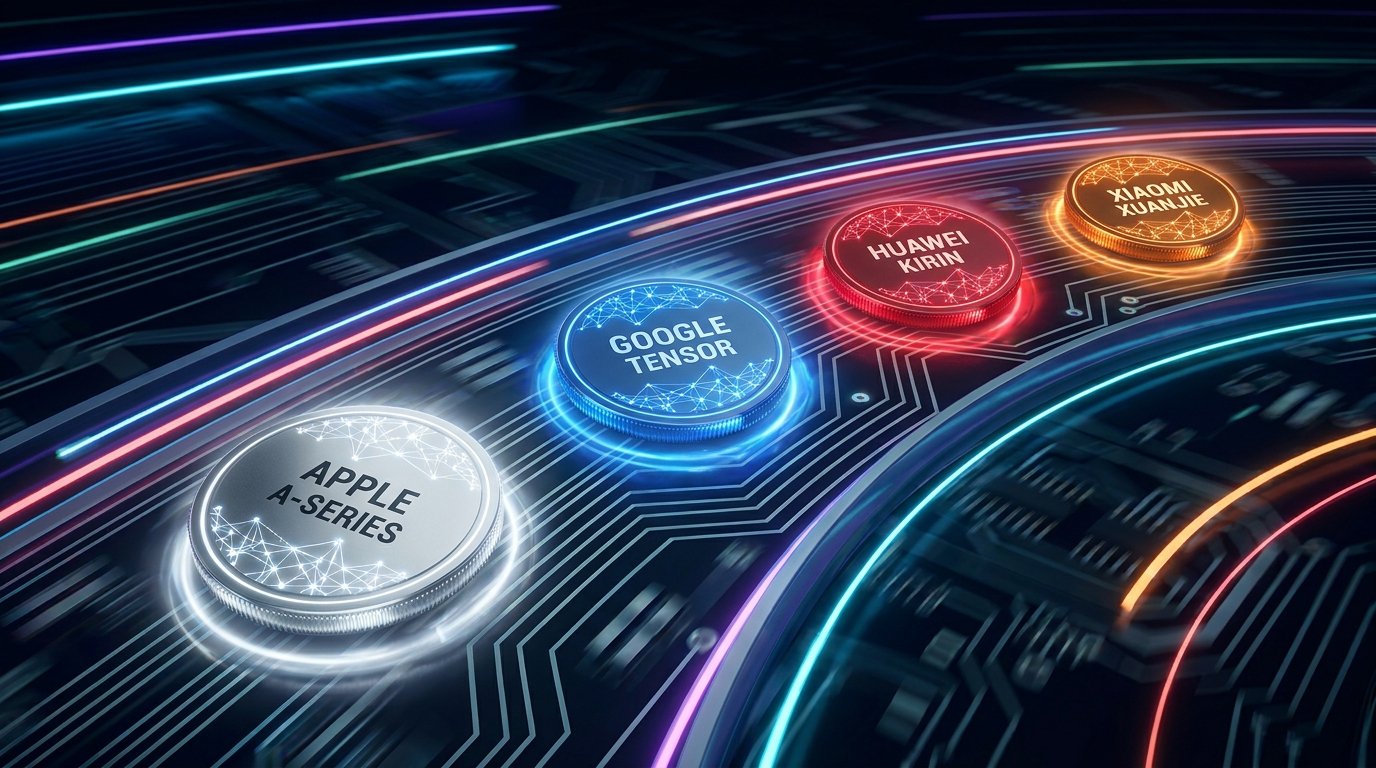
- Apple, Google, Huawei, and Xiaomi are using custom silicon to control latency, memory movement, power use, and AI workload scheduling instead of treating the processor as a generic component.
- Xiaomi's 2026 portfolio now spans three different roles: XRING O3 for flagship mobile devices, O100 for high-bandwidth MiMo acceleration on consumer devices, and D100 for intelligent driving.
- Vendor TOPS, uplift, and specification claims are useful launch signals, but they need independent retail testing across thermals, battery life, memory pressure, cloud handoff, and sustained AI workloads.
- For phone agents, the chip is only the compute layer; useful execution also needs current context, supported actions, permissions, confirmations, result evidence, stopping, retry, and recovery.
Why Custom Mobile Silicon Matters for AI
The AI chip race 2026 matters because phone makers are no longer optimizing only for camera pipelines, gaming peaks, and battery endurance. AI workloads move data differently. A phone that understands speech, reads a screen, analyzes an image, summarizes notifications, or helps prepare an action needs low latency, enough memory bandwidth, efficient neural processing, and software scheduling that does not burn through the battery after a few tasks.
Custom smartphone silicon gives a manufacturer more control over that path. Apple, Google, Huawei, and Xiaomi can tune the chip, operating system, model runtime, and product features together. That can reduce cloud round trips, keep some sensitive work closer to the device where supported, and make repeated small AI tasks feel immediate instead of heavy. Xiaomi's official XRING O1 release is useful context because Xiaomi framed chip, OS, and AI as foundational technologies rather than separate spec-sheet items.
The boundary is just as important as the opportunity. Custom silicon can improve model inference, memory movement, and power behavior, but it does not automatically create a useful phone agent. A faster NPU cannot grant app permissions, invent supported action surfaces, or prove that a task completed correctly. For readers who want the engineering side of local inference, On-Device LLM Optimization for Phone Agents: Android Speed, Privacy, and Actions explains why quantization, caching, context length, and scheduling matter alongside chip branding.
Apple's Integrated Silicon and Software Route
Apple's route is the cleanest example of vertical integration. Apple controls A-series silicon, iOS, Apple Intelligence, developer frameworks, and the privacy-oriented processing story around supported devices. The official Apple Intelligence overview presents a personal-intelligence system that uses supported hardware, software, and cloud processing where Apple makes it available.
That control helps Apple tune AI features for the device experience. When the system owns the chip and the operating system, it can coordinate on-device work, cloud-assisted work, personal context, app integration, and power behavior more tightly than a vendor assembling unrelated parts. For everyday users, the benefit can show up as more responsive writing tools, notification help, image features, and Siri improvements on eligible devices.
The agent question is narrower than the AI-feature question. Apple can make strong integrated experiences, but broad phone action still depends on supported app surfaces, developer adoption, system permissions, user confirmation, and availability by device, language, and region. A fluent Siri answer is not the same as a completed third-party app workflow. For readers comparing Apple's route with our Android execution model, FoneClaw vs Apple Intelligence keeps the product comparison focused on context, supported actions, and reviewable outcomes.
Google Tensor and the Android AI Route
Google's Tensor route starts from a different strength: Pixel hardware is designed around Google's AI and Android experiences. The current Google Pixel phone information positions Pixel as the phone line where Google can bring hardware, Tensor, Android, Gemini, camera processing, and assistant features together under one product umbrella.
Tensor is not simply a benchmark argument. Google has used the line to prioritize speech, image processing, language features, and AI-assisted phone experiences that connect tightly with Google services. That makes Pixel a useful proving ground for Android AI because Google can ship model-side features, operating-system hooks, and app experiences in a coordinated way.
The practical limit is device and ecosystem scope. Pixel capability should not be projected onto every Android phone, and Tensor-backed features should not be assumed to run fully on-device just because the phone has custom AI silicon. Android is broad: OEMs, regional builds, app permissions, Google service availability, and hardware tiers change the experience. Readers checking Android AI support by device can continue with Gemini Intelligence Supported Devices, where the device and rollout question is handled directly.
For phone agents, Tensor helps when it makes context understanding and inference faster, but the final value still comes from whether a supported action can be prepared, approved, executed, and verified on the phone.
Huawei Kirin and the HarmonyOS Route
Huawei's route is another vertical-integration strategy, shaped by a different market and supply-chain context. Huawei presents its consumer ecosystem through devices, HarmonyOS, and AI services on the official Huawei consumer site. The Kirin line sits inside that broader effort to coordinate silicon, system software, and domestic ecosystem capabilities.
The strongest part of Huawei's story is strategic control. When the same company designs devices, system software, services, and silicon direction, it can build experiences that are less dependent on external platform choices. In markets where Huawei's ecosystem is strong, that can support context-aware features, cross-device continuity, and assistant behavior that is tuned for Huawei's own apps and services.
The hard part is evidence. Process details, benchmark comparisons, and performance narratives around Kirin often require careful sourcing because independent testing can be less uniform than it is for globally distributed Apple, Google, or Qualcomm-based devices. For this comparison, the useful conclusion is not that Kirin wins or loses one permanent ranking. It is that Huawei is pursuing the same high-level pattern: custom compute matters most when it is connected to an operating system, app ecosystem, and action model.
That distinction matters for AI phone agents. A strong on-device AI phone agent chip can accelerate understanding, but it does not define app access by itself. Huawei's route should be judged by actual assistant workflows on supported devices, including context use, permissions, user confirmation, completion evidence, and recovery. Our Huawei phone agent guide continues that ecosystem-specific question.
Xiaomi's XRING O3, O100, and D100 Portfolio
Xiaomi is the biggest update in this article because its custom-silicon story is no longer only an XRING O1 self-reliance chapter. In 2026, Xiaomi announced a three-chip portfolio: XRING O3, O100, and D100. Current Xiaomi XRING O3, O100, and D100 launch reporting describes O3 as the flagship mobile SoC, O100 as a high-bandwidth AI accelerator, and D100 as an intelligent-driving chip. These chips are complementary because they target different compute environments, not interchangeable benchmark slots.
XRING O1 remains the historical baseline. Xiaomi's official O1 material said the chip used a second-generation 3 nm process, a ten-core CPU, a 16-core GPU, and a six-core NPU rated by Xiaomi at 44 TOPS. Those are Xiaomi-stated specifications and claims, but they show the direction: Xiaomi wanted a self-developed flagship mobile SoC tied to its chip, OS, and AI strategy.
XRING O3 is the 2026 flagship mobile-SoC step. Android Authority's pre-launch Xiaomi 18 Fold status report says O3 uses a ten-core CPU and a new Arm GPU according to Xiaomi's published information, and it emphasizes that independent testing is still needed for performance claims. O3 matters most for phones and foldables because it can influence latency, power, image and screen understanding, local model behavior where supported, and the responsiveness of assistant features on a mobile device.
O100 has a different job. A Reuters report on Xiaomi's three-chip launch describes O100 as a 6 nm NPU supporting MiMo on consumer devices, with TSMC production context. That makes O100 closer to a high-bandwidth AI acceleration layer for model workloads than a direct phone SoC replacement. If Xiaomi uses it to accelerate MiMo workloads in consumer hardware, the important tests will be throughput, memory bandwidth, cost, power, and how the device decides which tasks use which accelerator.
D100 is separate again. The same Reuters report and China Daily's Xiaomi chip report describe D100 as a 3 nm intelligent-driving chip, with China Daily attributing to Xiaomi a 20-core CPU, 16-core NPU, and support for up to 160 GB unified memory. China Daily also reports that O100 and D100 are scheduled for commercial deployment in 2027. Those details should be read as Xiaomi statements and launch reporting, not as retail validation.
For phone readers, the cleanest division is this: O3 is the chip to watch for flagship mobile AI behavior, O100 is the MiMo acceleration path to watch for high-bandwidth consumer-device workloads, and D100 is the intelligent-driving path. The three chips do not answer the same question. For device-specific O3, HyperOS 4, and MiMo depth, our Xiaomi 18 Fold AI Phone: XRING O3, HyperOS 4, MiMo, and What Retail Tests Must Prove guide tracks the foldable launch path. For the wider Xiaomi AI layer map, Xiaomi AI 2026 explains how MiMo, HyperOS, Super XiaoAI, and Xiaomi's agent history fit together.
AI Compute Is Not Phone-Agent Execution
The most useful conclusion from the XRING O3 vs Apple Tensor Kirin discussion is that AI compute and phone-agent execution are different layers. Compute helps the model understand voice, text, images, screen state, and intent. Execution requires the phone to know what context is current, which action is supported, which permission is granted, what the user must confirm, how the result is shown, and how the workflow recovers when something changes.
This is the lesson we keep applying while building FoneClaw. Faster inference helps, but it does not replace an action runtime. FoneClaw is designed for supported Android actions across brands, with user-provided screen and image context where applicable, visible progress, approvals for consequential steps, stopping, retry, permission recovery, Information Inbox, Memo workflows, and 100+ built-in tools that connect model plans to governed Android tasks. The current public capability surface is maintained on the FoneClaw Features page, and users can check current distribution options on the FoneClaw Download page before testing a reversible workflow.
That is why a higher TOPS number is not a complete phone-agent score. A chip can make OCR faster, summarization smoother, or multimodal analysis less expensive. It cannot make an unsupported app action safe, create user consent for a sensitive step, or prove that a message, calendar event, navigation action, or memo was completed correctly. Those belong to the operating system and runtime layer.
For repeatable testing, Android Phone Agent Benchmark Guide: Reliability, Safety, and Task Success turns chip claims into workflow checks. The broader architecture is covered in AI Agent Phone Control: context, planning, supported tools, confirmation, result evidence, and recovery are the parts that make the action usable.
Choose Hardware by Workflow, Not One Score
The buying question should start with the workflow. If your priority is Apple's personal-intelligence experience on supported iPhones, Apple's integrated silicon and software route is the relevant path to test. If you want Pixel-first Android AI and Gemini experiences, Tensor and Pixel support matter. If you live inside Huawei's device and HarmonyOS ecosystem, Kirin should be judged by that environment. If you are watching Xiaomi, separate XRING O3 for flagship mobile AI, O100 for high-bandwidth MiMo acceleration, and D100 for intelligent driving before comparing any numbers.
Use one score only as a starting clue. The practical checks are latency, battery impact, sustained thermals, memory pressure, offline behavior, cloud handoff, language and regional availability, supported app coverage, confirmation quality, and recovery from permission or account blocks. Vendor claims can guide what to test, but retail devices and real workflows decide whether the silicon improves daily use.
For Android users, we recommend testing the phone as an action carrier, not only as a chip container. Ask what the assistant can see, what it can prepare, what it can complete, where you approve, and what evidence appears afterward. AI Phones as the Carrier Layer for Phone Agents extends that idea from silicon to the full device stack: chip, OS, model, permissions, apps, and execution runtime all have to work together.
Sources: This update uses Xiaomi's official XRING O1 release, Xiaomi XRING O3/O100/D100 launch reporting, Reuters and China Daily reporting on Xiaomi's three-chip portfolio, Android Authority's Xiaomi 18 Fold pre-launch status, Apple's official Apple Intelligence overview, Google Pixel official information, Huawei consumer information, and FoneClaw's current Features and Download pages.