
FoneClaw vs Apple Intelligence: Siri AI vs Android Agent
Compare FoneClaw vs Apple Intelligence for phone automation, voice control, Android support, privacy, and real device actions.
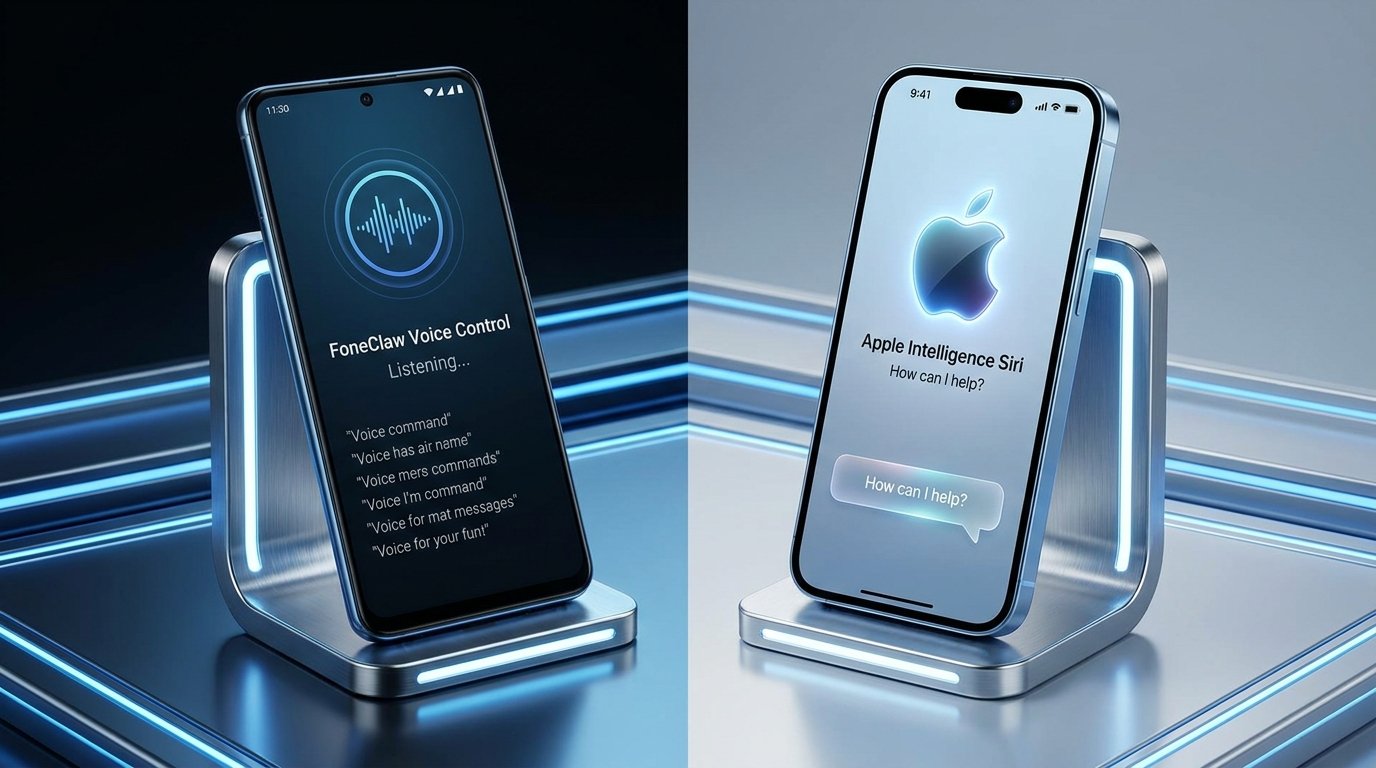
- FoneClaw is an Android AI agent for supported phone actions, not just a chatbot.
- Quick Answer: FoneClaw vs Apple Intelligence
- What Apple Announced at WWDC 2026
- Siri AI vs FoneClaw: Assistant or Phone Agent?
- App Intents vs Android Cross-App Control
- Quick Answer: FoneClaw vs Apple Intelligence
- What Apple Announced at WWDC 2026
- Siri AI vs FoneClaw: Assistant or Phone Agent?
- App Intents vs Android Cross-App Control
- On-Device AI and Privacy: Apple's Advantage
- Real Phone Execution: Where FoneClaw Is Different
- Human Approval: Why Phone Agents Need Confirmation
- FoneClaw vs Apple Intelligence Comparison Table
- Which Users Should Choose FoneClaw?
- Frequently Asked Questions
Quick Answer: FoneClaw vs Apple Intelligence
Apple Intelligence is becoming more agentic after WWDC 2026. Siri AI is being rebuilt around personal context, App Intents, on-device privacy, and deeper iOS actions. FoneClaw is different: it is an Android AI phone assistant focused on 120+ supported phone actions, voice-led workflows, transparent permissions, and user-approved results.
Apple’s own Apple Intelligence page and App Intents documentation are the right starting points for judging how far Siri can move from assistant responses toward app actions.
If you use an iPhone, Apple Intelligence and Siri AI are the natural choice because they are tied to iOS, Apple apps, and Apple's privacy model. If you use Android and want an assistant that can help complete supported phone actions, FoneClaw is the more relevant comparison. the difference is not only voice control. It is whether the assistant can move from understanding intent to completing a useful phone task.
The short version is simple: Apple Intelligence is Apple's system AI layer. FoneClaw is an Android execution layer. Apple is building a smarter assistant inside its ecosystem. FoneClaw is built for Android users who need practical phone actions across 16 supported feature categories today.
What Apple Announced at WWDC 2026
WWDC 2026 made Apple Intelligence more important to the phone agent conversation. Reports around the event describe a rebuilt Siri AI, stronger personal context, App Intents for machine-callable app actions, and new Apple Intelligence features across Safari, Photos, Shortcuts, and system workflows.
The most important shift is that Siri is no longer only a voice command tool. Apple is trying to make Siri understand what the user wants, connect that intent to app functions, and ask for confirmation before sensitive actions. Coverage also points to features such as webpage monitoring, password upgrade flows, camera-based Siri Mode, natural-language shortcut creation, and better cross-app actions.
This is a major change for Apple, but it also raises a useful comparison. Apple Intelligence works best inside Apple's controlled ecosystem. FoneClaw focuses on Android, where the user may need help with supported phone tasks such as device checks, notification and SMS summaries, settings, screenshots, configured email, calendar, notes, maps, navigation, and web tasks.
Siri AI vs FoneClaw: Assistant or Phone Agent?
Siri AI is becoming more like an AI agent with agentic features. It can understand more context, work with Apple apps, and call supported app actions through Apple's frameworks. That makes it much more capable than the old Siri, especially for iPhone users.
FoneClaw is closer to a practical Android phone AI agent. It is designed around completing supported Android phone workflows, not only answering questions. A phone AI agent needs to read relevant phone context, follow visible steps, respect permissions, pause for approval, and return a clear result.
this difference matters most when the task is messy. Asking "what is the weather" is an assistant task. Asking "summarize today's SMS, draft a reply, and send only after I approve" is a phone-assistant task. Apple is moving Siri toward that second category on iOS. FoneClaw is focused on practical supported phone actions for Android.
App Intents vs Android Cross-App Control
App Intents are central to Apple's strategy. They let developers expose app functions so Siri and Apple Intelligence can call them. In simple terms, Apple wants apps to become machine-callable. If an app supports the right intent, Siri can trigger that app action more cleanly.
The limitation is support. App Intents depend on developers implementing the right actions and Apple approving the platform rules. If an app does not expose the action Siri needs, the assistant may not be able to complete the task. This creates a controlled but dependent execution model.
FoneClaw approaches Android from the practical phone-action side. Instead of promising unlimited app control, it organizes supported actions across phone status, notifications, SMS, calls, settings, connectivity, screenshots, screen reading, email, calendar, notes, maps, navigation, web tasks, workflows, and app-interface quick commands. For Android users, reliable supported actions are more important than a polished demo inside one platform ecosystem.
On-Device AI and Privacy: Apple's Advantage
Apple has a strong privacy position. Apple Intelligence emphasizes on-device processing where possible and Private Cloud Compute for larger tasks. That matters because Siri AI may handle messages, photos, webpages, passwords, app actions, and personal context. Users should expect Apple to keep privacy at the center of the product.
FoneClaw also treats privacy as a core part of phone control. A phone agent may see sensitive app screens, notifications, and draft messages. That is why local processing, clear permissions, and user confirmation are essential. users trust phone agents more when they can see what is happening and approve the final action.
The important lesson is that privacy is not only a model-location question. It is also an execution-design question. A safe phone agent should not silently send messages, change passwords, make purchases, or move money. Apple and FoneClaw both point toward the same rule: sensitive actions need clear user approval.
Real Phone Execution: Where FoneClaw Is Different
FoneClaw is different because it focuses on Android phone results. It is not just a chatbot, and it is not only a search assistant. The goal is to help the user complete supported phone actions with voice-led steps. That includes device health checks, message and notification summaries, supported setting changes, screenshots, configured email, calendar, maps, navigation, and routine phone tasks while keeping the user in control.
This matters because the next assistant race is not only about model intelligence. A model can understand a request and still fail to produce a phone result. Real Android assistance requires permissions, supported action coverage, screen or notification context where needed, setup clarity, error handling, and final confirmation.
For example, a user may want to check phone status, summarize notifications, prepare a message, save a local note, add a calendar item, or open navigation in an installed map app. Apple Intelligence may become very good at iOS-native tasks. FoneClaw is built for Android-side phone assistance on the device users already own.
Human Approval: Why Phone Agents Need Confirmation
The more powerful a phone agent becomes, the more important confirmation becomes. Apple appears to understand this: many Siri AI actions still require user approval, especially when the action affects messages, passwords, purchases, or personal data. That is not a weakness. It is the right safety design.
FoneClaw follows the same principle. A useful Android phone AI agent should reduce tapping, not remove user control. It can prepare supported actions, summarize information, change supported settings, or organize the next step, but sensitive actions such as sending SMS or email should remain visible and approved.
Based on our analysis, human approval is what separates a helpful agent from a risky automation tool. The best phone agent is not the one that acts without asking. It is the one that does the boring work, shows the result, and lets the user make the final call.
FoneClaw vs Apple Intelligence Comparison Table
| Dimension | Apple Intelligence / Siri AI | FoneClaw |
|---|---|---|
| Platform | iPhone, iPad, Mac, Apple ecosystem | Android phones |
| Main role | Apple system AI agent | Android phone AI agent |
| Action model | App Intents and Apple system integration | 120+ supported Android actions across 16 categories |
| Best for | Apple users who want iOS-native AI | Android users who need practical phone results |
| Privacy model | On-device processing plus Private Cloud Compute | Transparent permissions and visible approval |
| Setup requirements | Depends on Apple device and app support | Some actions require permissions, IMAP/SMTP, maps, or overlay setup |
| Sensitive actions | Should require confirmation | Should require confirmation |
FoneClaw focuses on supported Android phone actions with visible results, permission-aware flows, user confirmation, and practical fallback. Apple Intelligence is a platform-native assistant for Apple users. FoneClaw is an Android phone AI agent focused on supported phone actions and visible results. The overlap is voice and AI. The difference is where the work gets done.
Which Users Should Choose FoneClaw?
Choose FoneClaw if you use Android and want more than answers. It is most useful when your daily pain is checking phone status, managing notifications and SMS, changing settings, using screenshots, configured email, calendar, notes, maps, navigation, and other supported Android actions while your hands are busy.
Choose Apple Intelligence if you live inside the Apple ecosystem and want Siri AI, Apple apps, App Intents, and Apple's privacy model to work together. For iPhone users, Apple Intelligence is the natural system layer.
The best choice depends on your device and your task. If the question is "which assistant knows more," Gemini or Siri AI may be the right comparison. If the question is "who can help me turn Android commands into visible phone results," FoneClaw is the more relevant answer.