
Why Local AI Agents Like FoneClaw Never Go Down
Cloud AI agents crash. Local AI agents keep working. Learn why on-device processing means your phone automation never stops.
- FoneClaw is an Android AI phone assistant for supported phone actions, not just a chatbot.
- When Cloud AI Goes Dark
- How Cloud AI Creates Vulnerability
- Why Local Processing Never Experiences Downtime
- Privacy Benefits of On-Device AI
When Cloud AI Goes Dark
You are in the middle of sending an urgent message through your voice assistant when the screen freezes. A small spinning wheel appears, followed by a frustrating error message saying the server cannot be reached. In that moment, your highly advanced phone assistant becomes nothing more than an expensive paperweight. This is the silent vulnerability of cloud-dependent tools that millions of users face every single day.
When you rely on external servers to process simple tasks, you hand over control of your daily workflow to factors completely outside your reach. A minor fiber optic cable cut thousands of miles away or a sudden spike in global server traffic can instantly disable your tools. Your device might have the fastest chip on the market, but it remains helpless without an active, high-speed connection to a distant data center.
cloud-based assistants experience brief interruptions or slowdowns far more often than providers admit. These micro-outages might only last for a few seconds, but they completely disrupt the flow of automated tasks. When an automated agent is supposed to run in the background to organize your files or send scheduled replies, even a temporary loss of connection causes the entire sequence to fail.
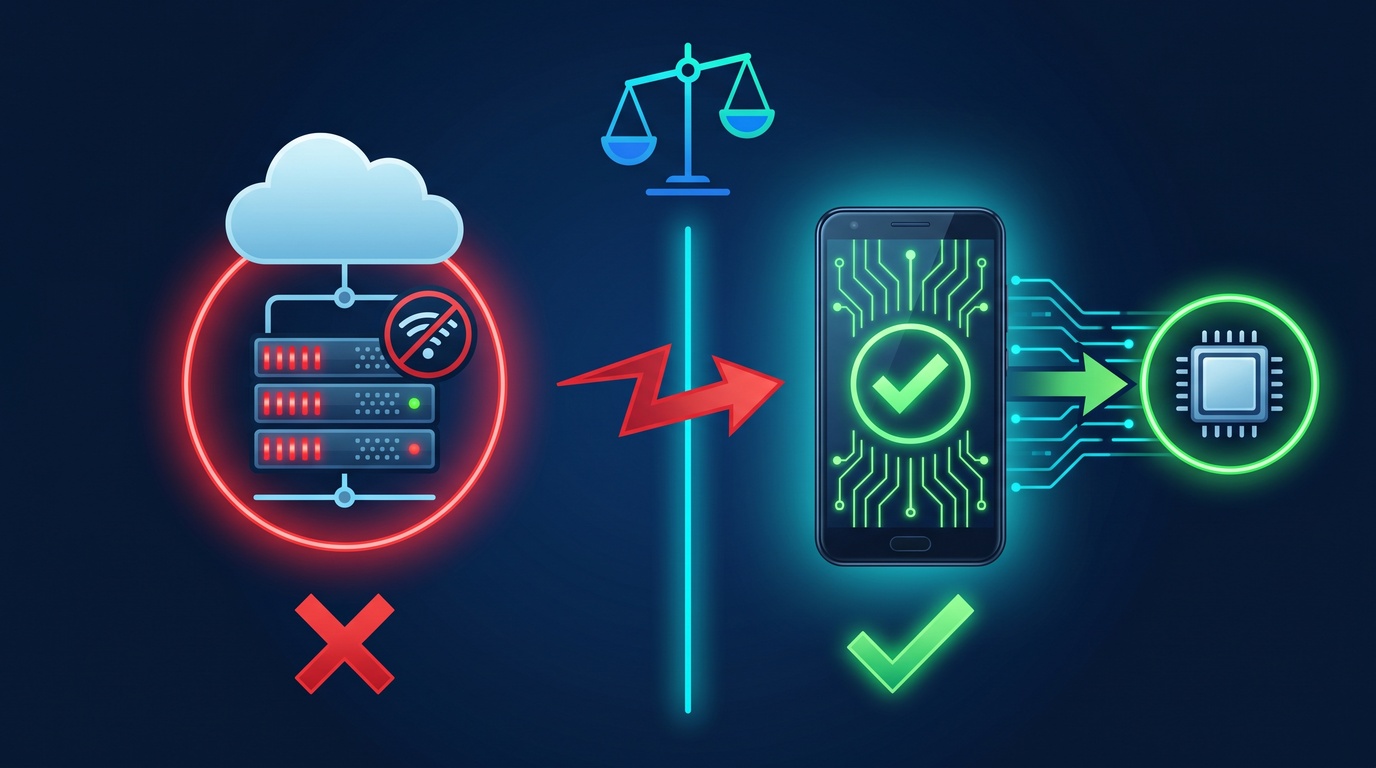
Local alternatives solve this fundamental design flaw by keeping all processes on your physical hardware. Instead of sending your voice and data across the internet, these tools run directly on your phone's processor. This shift in design ensures that your automation tools remain active, fast, and completely immune to external server crashes.
How Cloud AI Creates Vulnerability
Cloud AI agents follow a simple architecture: your phone captures audio, sends it to remote servers, waits for processing, and then receives the command back. This constant back-and-forth communication creates multiple points of failure. If your cellular signal drops for a moment, or if the server experiences a heavy load, the entire process stalls. Your phone is merely acting as a screen and a microphone, outsourcing all the actual thinking to a remote location.
This dependency introduces latency that makes real-time automation feel sluggish and unreliable. Every command you give must travel through cell towers, underwater cables, and complex server switches before it can execute on your screen. When you try to chain multiple actions together, such as copying text from an email and pasting it into a messaging app, this delay multiplies with each step.
a typical cloud-based automation sequence requires up to five times more data transfer than a local equivalent. This high data requirement makes cloud assistants highly impractical when you are traveling, commuting through tunnels, or working in areas with poor network coverage. When the network connection is weak, the assistant simply stops working, leaving your scheduled tasks incomplete.
In addition, the financial cost of running massive cloud servers forces companies to impose strict rate limits on users. If you run too many automation tasks in a short period, the provider may throttle your speed or temporarily block your access. This makes cloud-hosted systems a poor choice for serious users who need consistent, high-frequency automation throughout the day.
Why Local Processing Never Experiences Downtime
Local AI agents like FoneClaw process voice commands and automation tasks entirely on your Android device. Your phone captures your input, analyzes the intent, and executes the action directly on its own silicon. Because there is no external server involved in the decision-making process, there is no server to crash, no API to time out, and no connection to lose. Your automation tools work just as well in the middle of a remote forest as they do in a high-tech office.
Modern smartphone processors are equipped with dedicated neural processing units designed specifically for these heavy tasks. By running models like Xiaomi's MiMo or other efficient local models directly on your hardware, FoneClaw can trigger actions instantly. The elimination of network lag means your phone responds to commands in milliseconds, creating a much smoother user experience.
local execution removes the unpredictable delays that plague cloud-based services. When you run an automated workflow on FoneClaw, the execution time remains virtually identical every single time you trigger it. This predictable performance is essential for building complex, multi-step routines that require precise timing to succeed.
By keeping everything on-device, you also avoid the risk of service discontinuation. When a cloud AI company goes out of business or changes its API terms, its users are left with broken tools. A local agent, however, belongs entirely to you; as long as your physical phone turns on, your automated workflows will continue to run exactly as you set them up.
Privacy Benefits of On-Device AI
Beyond reliability, local processing provides significant privacy advantages that cloud agents cannot match. When you use a cloud-based assistant, your voice recordings, personal messages, and app data are uploaded to third-party servers. Even if the company promises to protect your information, sending sensitive data over the internet always opens up risks of interception, data breaches, or unauthorized access by staff.
With local AI agents, your personal data never leaves your physical device. Your emails, contact lists, and private messages are processed locally in your phone's secure memory. This design makes it virtually impossible for external hackers to steal your information during transmission, as there is no transmission happening in the first place. You maintain total ownership and control over your digital footprint.
Many businesses and professionals avoid using automation tools because of strict data compliance laws like GDPR or HIPAA. Cloud-based tools often fail to meet these high standards because they store and process sensitive user data on external servers. Local processing bypasses these regulatory hurdles entirely, allowing professionals to automate their workflows without worrying about costly compliance violations.
By running models locally, you also avoid having your personal interactions used to train public AI models. Many cloud providers use your prompt history to improve their systems, which can sometimes lead to accidental leaks of proprietary information. Local agents keep your data private, ensuring that your unique workflows and personal habits remain exclusively yours.
Real-World Scenarios Where Reliability Matters
The reliability differences between cloud and local agents become critical in specific real-world scenarios where failure is not an option. Consider a professional who uses automated systems to log incoming client calls and send immediate follow-up messages. If the cloud server crashes during a busy afternoon, potential clients are left waiting, which can lead to lost business opportunities and damaged professional relationships.
Another common scenario is international travel. When you step off a plane in a foreign country, your cellular connection is often slow, expensive, or completely unavailable until you find a local SIM card. A local agent like FoneClaw allows you to run your travel organization scripts, search your offline notes, and manage your device settings without needing to pay for expensive roaming data.
Emergency situations also highlight the need for offline functionality. If you find yourself in an area with poor coverage during a storm or power outage, you cannot rely on cloud services to help you manage your device. A local agent can still execute emergency routines, look up stored medical information, or run offline scripts to help you get through difficult situations safely.
Finally, daily routines like morning alarms, calendar updates, and task lists need to work every single day without fail. If your morning routine automation relies on a cloud API that happens to be undergoing scheduled maintenance at 6:00 AM, your day starts with a broken schedule. Local agents ensure that your daily habits remain structured and reliable, regardless of what is happening in the tech world.
The Future of Reliable AI Architecture
The industry is moving toward hybrid architectures that combine local processing with optional cloud features, but local execution remains the foundation of true reliability. As mobile processors become faster and more energy-efficient, the need to send basic tasks to the cloud is rapidly disappearing. The future belongs to smart devices that can think, plan, and act independently of a constant internet connection.
Startups like FoneClaw are leading this shift by showing that you do not need massive server farms to build highly capable mobile assistants. By optimizing models to run on standard Android hardware, these tools deliver fast, reliable automation that respects user privacy. This approach makes advanced technology accessible to everyone, even those living in areas with poor digital infrastructure.
As users become more aware of the risks associated with cloud dependency, the demand for local-first software will continue to grow. People want tools that they can rely on during critical moments, not services that can disappear at any moment due to a server error. Investing in local AI architecture is not just a trend; it is a necessary step toward building a more stable and secure digital life.
Ultimately, the choice between cloud and local AI comes down to control. By choosing a local agent, you take back control of your phone and your personal data. You ensure that your automated systems work on your terms, on your schedule, and under your direct supervision, making your mobile experience truly your own.