
AI Agent Sandbox vs Phone Permissions: Why Secure Agents Still Need Boundaries
Use Perplexity SPACE as the market signal to understand why secure agent runtimes help, and why Android phone actions still need permissions, visible steps, and user confirmation.
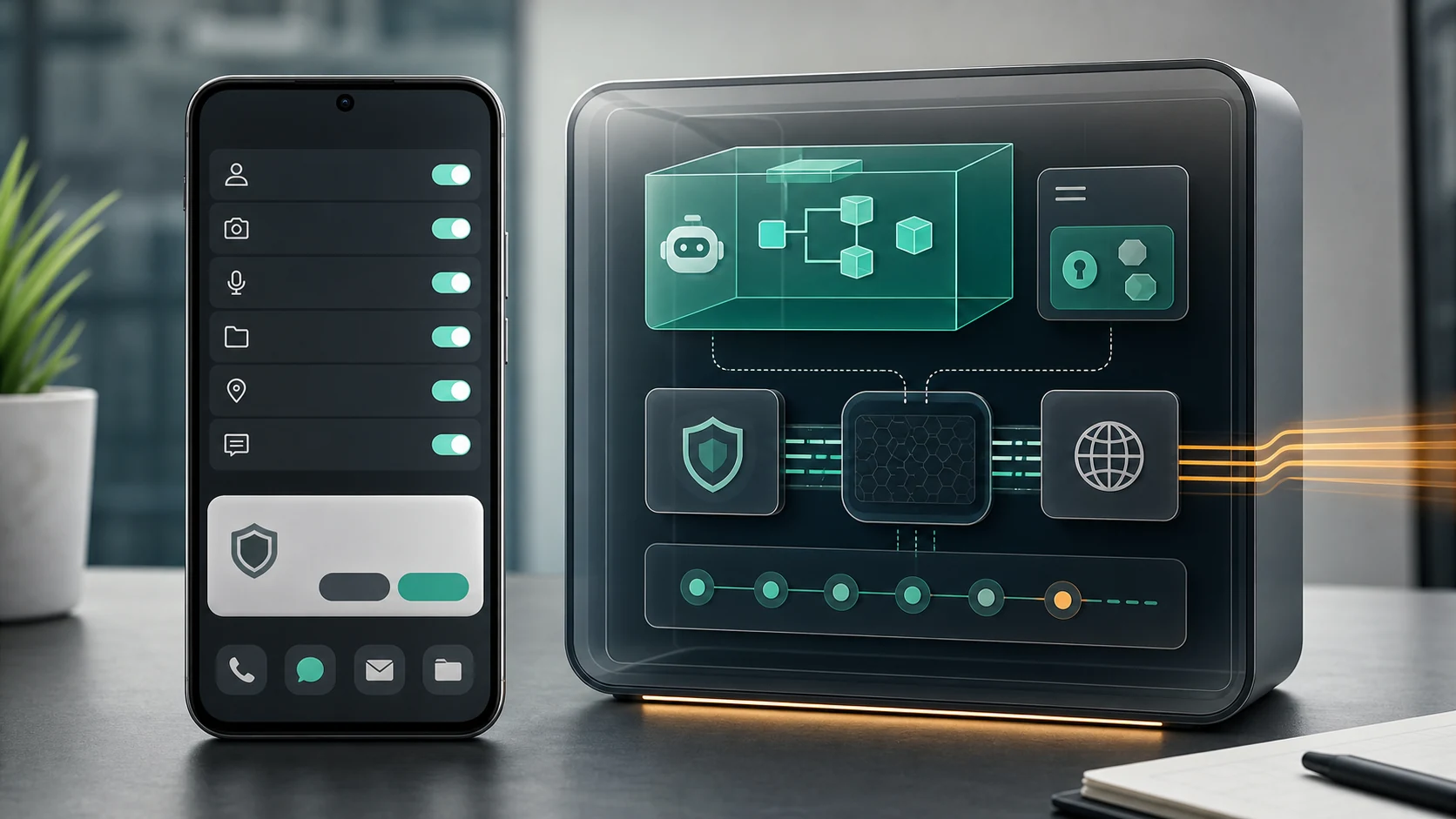
- An AI agent sandbox helps isolate long-running agent work, code, files, network access, credentials, and recoverable state.
- Perplexity introduced SPACE on July 15, 2026 as a secure runtime platform for long-running agent workflows and isolated code work.
- A sandbox can make agent infrastructure stronger, but Android calls, messages, payments, settings changes, and cross-app actions still need phone-side permissions and visible approval paths.
- FoneClaw’s product approach keeps model choice configurable while FoneClaw performs supported Android actions with visible results, permissions, confirmations, and practical recovery paths.
Why AI Agent Sandboxes Became a July 2026 Signal
An AI agent sandbox matters because agents are moving from short answers into long-running work. A model may write code, inspect files, open tools, run commands, wait for human input, resume later, and keep state across hours or days. That makes the runtime environment as important as the model itself. If the environment is loose, a capable agent can become messy. If the environment is controlled, the agent has room to work while the host, other users, and sensitive credentials stay protected.
On July 15, 2026, Perplexity Research introduced SPACE as a secure and efficient sandbox platform for long-running agent workflows and isolated code work. Perplexity framed the problem clearly: agents need environments that can run code, edit filesystems, complete multi-step tasks, preserve long-lived state, and protect hosts, tenants, and credentials. It also reported millions of sandbox creations during the launch period for Computer.
The phone-agent implication is precise. Sandboxing is a major part of agent infrastructure, but it answers a runtime question: where does the workload run, what can it touch, and how is it contained? Android phone actions ask a second question: what is the agent allowed to do on the user’s device? FoneClaw focuses on that phone side. We support configurable models that drive the agent’s understanding and planning, while FoneClaw performs supported Android actions through visible results, Android permissions, confirmations, and practical recovery paths.
What a Sandbox Actually Helps Solve
A sandbox gives an agent a controlled place to work. Perplexity describes SPACE as using a control plane, node-local services, and a sandbox implemented as a virtual machine with an in-guest daemon. In everyday terms, the system separates the coordinator, the local services that prepare and manage the runtime, and the isolated environment where the agent workload runs. That separation helps with scheduling, storage, networking, lifecycle management, and fault recovery.
The details matter because agents are no longer only stateless chat sessions. SPACE is described as supporting long-lived state, pause and resume, snapshots, session forking, network controls, and recoverable workflows. SiliconANGLE’s report on Perplexity SPACE adds market context, describing microVM-style isolation, pause and resume, session forking, credential isolation, forwarding, and orchestration as part of the launch signal. Those are infrastructure tools for agents that need to keep working after the first prompt.
Credential handling is one of the strongest lessons. Perplexity says credentials stay outside the sandbox and are mediated by a credential store, gateway, vault backend, expiry, rate limits, and logging. That is useful because agents often need access to services without keeping keys inside the untrusted workload. For phone agents, the parallel is clear: strong containment helps, but it is still distinct from Android permission decisions. A safe runtime can prepare work; the phone still needs user-granted authority before calls, messages, app changes, account actions, or settings updates happen.
What a Sandbox Does Not Authorize on a Phone
A secure sandbox does not automatically give an agent the right to act on a phone. It can isolate code, preserve state, mediate credentials, and control network reach. It does not, by itself, grant contact access, call authority, SMS sending, notification reading, payment approval, accessibility access, location sharing, system-setting changes, or cross-app Android actions. Those belong to Android, app APIs, user permissions, and the visible action flow on the device.
This distinction is the core of the sandbox-versus-phone-permissions question. A cloud or desktop agent may run safely in a virtual machine and still have no legitimate route to send a text from your Android phone. A phone agent may understand your intent perfectly and still need Android permission, an app-supported action path, and a final confirmation before the action completes. Security at the runtime level and authority at the device level work together, but one does not replace the other.
That is why FoneClaw keeps phone actions bounded by what the Android side supports. A model can drive the agent’s reasoning, but FoneClaw performs supported Android actions with visible steps. When the action affects another person, private data, payment, location, or account state, confirmation belongs in the user’s view. For readers who want a deeper permission-focused companion piece, AI Agent Skill Security Needs Phone Permission Checks explains why every action skill needs phone-side approval rules, not only model intelligence.
Phone Permissions Are a Separate Trust Decision
Phone-agent trust is built from human intent, model reasoning, Android permissions, visible progress, and confirmable results. A sandbox can keep an agent workload contained. A phone permission tells Android what an app or agent environment may access. A confirmation tells the user what is about to happen. These are different decisions, and strong phone-agent design treats them separately.
Operational reliability also matters. Perplexity’s public status history for Computer sandbox shows sandbox issues appearing in early July 2026, which is a useful reminder that runtime infrastructure is also an operations topic. Pausing, resuming, reconnecting, and recovering after faults are part of the product experience. On phones, similar practical questions appear in a different form: What if the app screen changes? What if a permission is missing? What if the user locks the phone? What if the requested action is outside the supported set?
FoneClaw’s answer is to keep the action state visible and recoverable. We use configurable models to drive understanding and planning inside the phone agent, but the Android action environment remains responsible for supported tasks, permissions, and confirmations. For readers comparing local, cloud, and phone-level trust patterns, AI Agent Trust: Local Android Phone Control vs Cloud Security gives broader context around where work runs and where user authority lives.
FoneClaw’s View: Configurable Models, Visible Android Actions
At FoneClaw, we see sandbox infrastructure as a valuable part of the agent market, but phone actions require a product design centered on the user’s Android device. FoneClaw is a phone agent. It can be driven by configurable AI models. The selected model helps the agent understand the request, reason about the task, and plan the next supported step. FoneClaw remains the environment where supported Android actions happen.
That distinction keeps the product experience clear. “FoneClaw plus a model” means the model drives FoneClaw’s agent. It does not mean two separate app experiences are stitched together. The model helps with intent and planning. FoneClaw handles supported Android action work: opening app paths, preparing messages or reminders, reading visible state where supported, managing permissions, and asking before sensitive final steps. If a request is outside the supported set, FoneClaw gives a practical next step instead of pretending the phone can do anything silently.
We also treat security as a reader-facing product quality, not a vague promise. A strong phone agent should make it easy to know what will happen, which app or permission is involved, and where user approval is needed. OpenClaw Security Risks vs FoneClaw: Safer Boundaries for Phone Agents explains why broad automation needs clearer action limits, while Enterprise AI Agent Security: A Local-First Model for Phone-Level Automation gives the enterprise angle on keeping phone-level work governed and visible.
Checklist for Sandboxed Agents That Want Phone Actions
Use this checklist when judging an AI agent sandbox or any agent that claims it can act on a phone. First, ask what the sandbox protects. Does it isolate workloads from the host and other tenants? Does it keep credentials outside the agent workspace? Does it control network reach and support recovery after a failed task? Second, ask what state it preserves. Long-running agents need pause, resume, snapshots, and a way to return without losing every step.
Third, separate runtime safety from Android authority. A sandbox can be well designed while the phone action still needs contact access, notification access, calling ability, messaging support, app integration, or accessibility consent. Fourth, look for visible action status. The user should see what app, contact, field, or setting is involved before completion. Fifth, insist on confirmation for sensitive steps. Sending, calling, paying, sharing location, changing account data, or exposing private information should keep the final decision with the user.
Sixth, check how the agent handles unsupported actions. A reliable phone agent should offer a supported next step when the request cannot be completed in the current phone state. Seventh, check model configuration. In FoneClaw, a configurable model drives the phone agent’s understanding and planning, while FoneClaw performs supported Android actions with visible results, permissions, confirmations, and recovery paths. That is the practical bridge between secure agent infrastructure and trustworthy phone work.