
Android App Update Verification, Retry, and APK Cleanup
Verify an Android app update, complete installer confirmation, classify failures before retrying, and delete the downloaded APK without uninstalling the app.
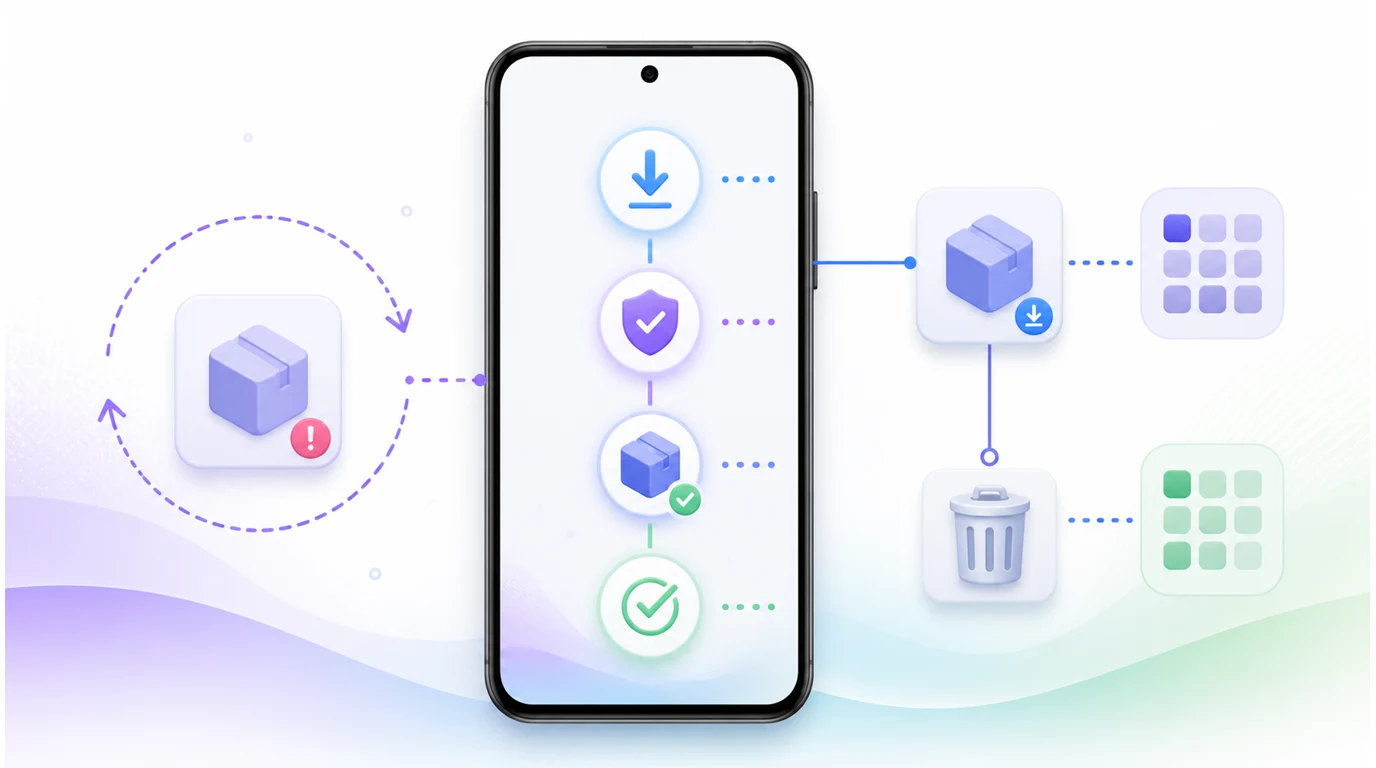
- Treat available, downloading, verifying, awaiting confirmation, installed, and failed as separate update states with different next actions.
- Android accepts an update when the application identity, signing relationship, and version rules match the installed app.
- Verify the installed package and essential app state before retrying a failure or deleting the downloaded installer.
- FoneClaw presents clearer update states and bounded install, retry, and package-delete actions from its Home experience.
An Android app update is complete only when Android reports installation success and the expected package version is present. A finished download, a full progress bar, or a closed installer window describes an intermediate event rather than final evidence.
Use a state-based workflow: identify the current state, take one bounded action, wait for success or failure, and inspect the installed package before cleanup. This preserves the existing installation and its user data while keeping retry decisions tied to the actual cause.
Read the Android Update State Before Acting
Start by naming the visible state. FoneClaw's current Home update experience separates download, verification, completion, and failure while presenting install, retry, or delete-package actions when they fit the state.
| Visible state | What it means | Next action | Success evidence |
|---|---|---|---|
| Update available | A newer package is offered through the selected channel | Confirm source, package identity, network, and storage | The intended download begins |
| Downloading | Package bytes are still being transferred | Wait or cancel deliberately if conditions changed | The complete file reaches verification |
| Verifying | The downloaded package is being checked before installation | Wait for ready or failure | The package becomes ready for Android installation |
| Ready to install | The package passed the current pre-install checks | Open the Android installer | The system confirmation screen appears |
| User action required | Android is waiting for an installation decision | Review and complete the system prompt | Android returns terminal success or failure |
| Installed | The installer reported success | Compare the installed version and open the app | The expected package is active and essential state remains available |
| Failed | Download, verification, policy, identity, storage, or installation stopped | Classify the cause before retrying | A corrected attempt reaches installed state |
Progress measures activity inside one state. Completion evidence proves that the workflow reached its intended terminal state. Keep those concepts separate when deciding whether to install, retry, or delete the downloaded APK.
Confirm the Update Source and App Identity
Identify whether Google Play manages the installed app or whether you are following a direct package flow. The distribution channel determines where you should look for the current package, release information, and update controls. Mixing channels without checking package identity can lead to an installer rejection even when both files display the same app name.
Android evaluates an update using the application ID, accepted signing-certificate relationship, and version rules. Its official explanation of app updates states that the update package must match the installed application identity and signing relationship while meeting the required version-code conditions.
Record four details before starting:
- The installed app and package identity.
- The channel that supplied the current installation.
- The official source for the proposed update.
- The expected newer version associated with that source.
Preserve the installed app while diagnosing an update. Uninstalling first can remove local app data and turns an update problem into a fresh-install problem. A signing or package-name conflict deserves source verification rather than destructive trial and error.
For a detailed channel comparison, Google Play vs Direct APK for Android AI Agents: How to Choose and Verify explains how managed-store updates and direct packages differ in source, installer flow, and verification.
Check Network, Storage, and Package Readiness
Before downloading, confirm that the phone has enough free storage for the package, temporary installation work, and the resulting app update. The APK size alone is not the complete requirement because Android may need additional working space while staging and optimizing the installation.
Use a stable connection suited to the package size. On a metered mobile network, decide whether the update is urgent enough to use that data or whether Wi-Fi is preferable. If connectivity changes during the transfer, inspect the current file and download state before starting another copy.
Avoid collecting multiple files with similar names. Keep one intended package tied to its official source and update attempt. If a prior download is incomplete or has a terminal verification failure, remove or replace that specific file only after identifying it. A complete file should move into verification rather than triggering another download by default.
Download failures and installer failures require different fixes. A connection interruption happens before the package is ready. An identity, certificate, policy, or system-confirmation failure occurs later. Restarting the download can repair missing bytes, while it leaves an incompatible package unchanged.
The preflight passes when storage is sufficient, the selected connection is stable, the source is current, and one identifiable package is ready to download. Then let the transfer reach a terminal download result before deciding whether retry is useful.
Verify the Package Before Opening the Installer
When the state says “verifying,” let that check finish. Verification is the gate between receiving a file and presenting it to Android for installation. Its successful completion means the package is ready for the next step; installation success still comes later.
Treat the filename as a convenience label. Android package information provides stronger identity evidence. The PackageInfo API reference documents fields for version name, long version code, and signing information when requested with the relevant flags.
For an update, compare:
- The package's application ID with the installed app.
- The proposed version code with the installed version code.
- The signing relationship expected for that application and channel.
- The package source with the official distribution path you selected.
Android checks certificate relationships during upgrades, including supported certificate-rotation paths. The Android app-signing documentation explains how signing identity supports trusted app updates. A certificate mismatch points back to source or package compatibility; repeated installation attempts preserve the same mismatch.
First-time installation raises additional source and permission questions. Can an AI Agent Install Android Apps? Google Play Safety and FoneClaw Workflow covers those installation decisions separately. For this update workflow, successful verification should lead to the Android installer while preserving the current app.
Complete Android Installer Confirmation
A “user action required” or “ready to install” state means the package is waiting for the Android system flow. Open the supplied installer prompt, review the app and requested action, and choose whether to continue. Keep the update task available while Android handles that decision.
Android stages package installation through PackageInstaller sessions. The PackageInstaller.Session documentation explains that committing a session can require user intervention and returns its outcome through a callback.
Android can report STATUS_PENDING_USER_ACTION when confirmation is needed. The PackageInstaller status reference describes the system action used to continue and identifies STATUS_SUCCESS as terminal installation success.
Stay with the system confirmation until it produces a result. Returning to Home, switching apps, or closing the installer may leave the request pending or canceled. Inspect the update state again instead of inferring an outcome from the disappearance of the installer screen.
After approval, wait for terminal success or a specific failure. That final status determines whether to verify the installed app, correct a problem, or retry a transient step.
Verify the Installed Version
Once Android reports success, inspect the package that is actually installed. PackageManager can retrieve the installed version information exposed through PackageInfo, including the version name and long version code. Compare that installed value with the expected update from the official source.
Then open the app and verify essential state:
- Confirm that the app launches normally.
- Check that the expected account or local profile remains available.
- Inspect one important feature or screen affected by the update.
- Return to the update view and confirm that it now shows completion or no pending update.
A human-readable version name helps the user recognize a release, while the version code provides a stronger ordered comparison for Android. Use both when they are available, and retain package identity as part of the check.
If Android reported success but the expected version is absent, refresh the installed-package state before another attempt. This guards against stale UI, checking the wrong channel, or comparing a package intended for another application variant.
After the app opens, device-level permission, battery, or health behavior may still need attention. Android Phone Health Check AI: Battery, Permissions, and Alerts provides the broader post-update checks beyond installer status.
Retry Only After Classifying the Failure
Retry when the failed state identifies a condition that can change. Refresh the state first, correct that condition, and then make one bounded attempt. Repeatedly pressing retry without changing the cause adds ambiguity and may create duplicate downloads.
Use these failure classes:
- Download interrupted: Check network and partial-file state, then resume or download one clean package.
- Insufficient storage: Free enough space for download and installation, then restart the affected step.
- User canceled: Reopen the installer only when you intend to complete confirmation.
- Pending after interruption or reboot: Refresh the session state and continue the recoverable installation path.
- Verification mismatch: Return to the official source and replace the incompatible or incomplete package.
- Package or signing identity failure: Confirm channel, application ID, certificate relationship, and intended app variant.
- Policy or installer restriction: Resolve the Android or distribution requirement before another attempt.
Some transient PackageInstaller session or data-loader failures can allow a pre-finalization session to be committed again. That recovery path depends on the session still being valid. Terminal identity, certificate, package-name, and policy failures require correction rather than repeated commitment.
Set a retry limit. One attempt after a targeted correction is usually enough to determine whether the cause was transient. Preserve the failure message and state when the same classification returns. For failures that continue after the app update itself succeeds, Phone Agent Debugging and Recovery: Fix Failed Android AI Assistant Tasks covers broader task-level diagnosis.
Delete the Downloaded Package Without Removing the App
Delete-package cleanup targets the downloaded installer file. The installed application remains a separate Android package with its existing app data. This makes APK cleanup useful after successful verification or when you intentionally abandon a failed download.
Use the quick delete action in two clear states:
- Installed and verified: Android reported success, the expected installed version is present, and the app opens with essential state intact.
- Abandoned package: You confirmed that the file is incomplete, incompatible, obsolete, or from the wrong source and will obtain a correct replacement.
Keep the downloaded file while installation status is uncertain. It may be the only complete recoverable package available for another installer confirmation or a transient retry. First refresh the update state, check the installed package, and decide whether the file still belongs to an active session.
Choose the action labeled for the downloaded package rather than Android's uninstall control. After deletion, verify that the APK is gone from the update or download location and open the installed app once more. The resulting evidence should show both outcomes: storage cleanup completed and the application remains installed.
Use the FoneClaw Update Loop From Download to Evidence
We designed FoneClaw's Home update experience around visible states because update controls are useful only when their target is clear. Download, verify, install, retry, completion, failure, and package deletion each belong to a specific point in the lifecycle.
The complete loop is:
- Start from the official FoneClaw package path shown on the Download page.
- Confirm the current update and begin one download.
- Watch the transfer reach verification rather than treating download completion as installation.
- Open the Android installer when the package is ready.
- Complete any required system confirmation.
- Wait for terminal success or a classified failure.
- Compare the installed package with the expected update and open FoneClaw.
- Retry once after correcting a transient cause, or retain the failure evidence for a persistent identity or policy issue.
- Delete the downloaded package after installed-state confirmation or intentional abandonment.
The Home action changes with the state. Install appears when a verified package is ready. Retry belongs to a failed step with a correctable cause. Delete package belongs to cleanup of the downloaded file. Completion should lead to installed-version verification rather than another download.
The official FoneClaw Download page provides the current package path and installation choices. The FoneClaw Features page maintains current product capabilities. Our update direction is straightforward: show the state, offer the bounded action that belongs there, and keep terminal evidence visible before cleanup.