
Android Voice Input vs Dictation vs AI Transcription
Compare Android voice commands, keyboard dictation, and AI transcription by output, accuracy, privacy, consent, and the result you need to verify.
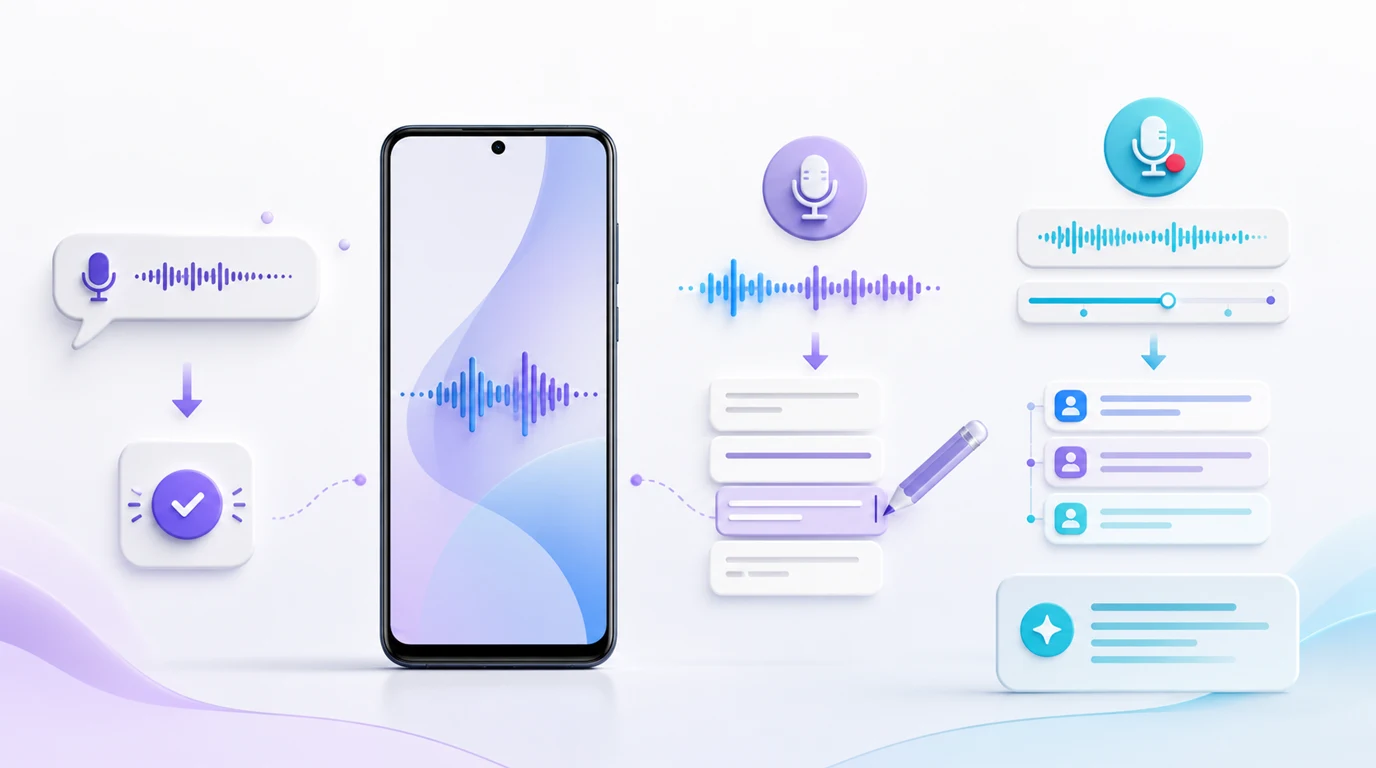
- Choose voice input for a phone action, dictation for editable text in a focused field, and AI transcription for a recording and transcript you need to keep.
- Accuracy depends on the task, selected language, microphone route, background noise, speaking style, and how carefully the result is reviewed.
- Saved recordings require clearer retention and participant-consent decisions than a short command or a dictated sentence.
- FoneClaw turns reviewed spoken intent into supported Android actions while keeping permissions, confirmations, progress, and final results visible.
Android voice input, dictation, and AI transcription all begin with speech, but they produce different results. Voice input turns intent into a supported phone action. Dictation places editable words in the active text field. AI transcription preserves a recording as a transcript that can be searched, corrected, summarized, or reviewed later.
The fastest way to choose is to name the result you need. Do you want Android to do something, words to appear in a message, or a conversation to remain available as a durable record? That decision should come before comparing model names or headline accuracy claims.
Choose the Right Android Voice Mode in Under a Minute
Use this Android voice input vs dictation vs AI transcription table to select a mode:
| Required result | Best starting mode | Typical example | What to verify |
|---|---|---|---|
| A change on the phone | Voice input or a phone agent | Open an app, adjust a supported setting, create a reminder, or prepare navigation | The requested Android state actually changed |
| Editable words in a field | Keyboard dictation | Compose a message, email, search, form response, or note | The text, punctuation, names, and destination are correct before submission |
| A saved audio record and transcript | AI transcription | Capture an interview, lecture, meeting, or extended voice note | The recording was saved and the transcript reflects the source audio |
The modes can also be chained. A meeting recorder can produce a transcript, an AI tool can extract a proposed follow-up, and a phone agent can execute the approved Android action. Each transition should preserve the source, target, timing, and approval decision.
A short request rarely needs a long recording workflow. Likewise, a 45-minute meeting should not be treated as temporary command input. Dictation belongs between those extremes when the desired result is text you can edit before using. For the broader design of speech-led phone interaction, Voice-First AI Phone Interaction: Intent, AI Keys, Screens, and FoneClaw explains how speech, screen context, and actions can work together.
Use Voice Input for Android Actions
Choose voice input when success means that the phone reaches a new, visible state. A request such as “Open Maps and prepare directions to the airport” is an instruction, rather than prose intended for a text box. The voice system must recognize the request, identify a supported action, resolve missing details, obtain the relevant permission or confirmation, execute the action, and show the result.
Android Voice Access illustrates the distinction between control and text entry. Its documented Voice Access commands include device-control operations as well as commands for entering text into a focused field. The same microphone can therefore serve two purposes, but the current mode determines whether speech is interpreted as an instruction or inserted as text.
Verification matters because a spoken acknowledgement is only an intermediate response. If the request was to change volume, check the resulting volume state. If it was to open an app, confirm the correct app is visible. If it was to create a calendar item or contact, review the target details and then verify that the saved record exists.
FoneClaw uses this intent-to-action pattern for supported Android work. A configured model interprets the spoken request, while our governed tools handle applicable phone permissions, approvals, execution, and visible task state. This is useful for app opening, supported system controls, current-screen tasks, communications, calendar work, navigation, and reusable workflows.
Use the Android Voice Control Guide: Setup, Hands-Free Tasks, Permissions, and FoneClaw Workflows when you need deeper help with microphone access, hands-free operation, Android setup, and phone-level controls.
Use Dictation for Editable Text
Choose dictation when you want speech to become text inside the field that currently has focus. Typical destinations include a message composer, email draft, search box, document, form, or note. The immediate result is editable text, so you can correct it before sending, saving, or submitting anything.
Gboard's voice typing controls let users dictate into supported text fields. Availability, controls, and languages vary by device and keyboard build. The focused field matters: speech can be recognized accurately but still land in the wrong conversation, search box, or form field if focus moved before dictation began.
Review proper names, numbers, email addresses, dates, and punctuation carefully. These details are often more consequential than an ordinary word substitution. A dictated message saying “Meet at 4:15” has a different effect if the result becomes “Meet at 4:50.” Keep submission as a separate action so the draft remains available for inspection.
On supported Pixel devices and languages, Gboard advanced voice typing adds richer voice controls and punctuation behavior. Device and Gboard language settings need to align for the supported experience. Other Android phones and keyboards may provide a different feature set, so verify commands on the keyboard actually installed.
Dictation works best for composed language: messages, paragraphs, search phrases, and form responses. If your intended words resemble an instruction, make the mode clear. “Write: remind Alex about the invoice” asks for editable text, while “Create a reminder to contact Alex about the invoice” asks for an Android action.
Use AI Transcription for a Durable Record
Choose AI transcription when the audio itself should remain available and useful after you stop speaking. The output usually includes a saved recording and a text transcript. Depending on the app and supported features, it may also include timestamps, speaker separation, search, corrections, summaries, or extracted action items.
This mode fits lectures, interviews, meetings, research conversations, and detailed voice notes. Long recordings contain context that temporary voice input may discard once a command is understood. Keeping the original audio lets you return to an unclear name, quotation, number, or decision instead of relying entirely on generated text.
Pixel Recorder supports creating and managing recordings through audio and transcript views. Google's Pixel Recorder management guidance covers editing, trimming, and organizing recordings. Its transcription management documentation also describes supported language, summary, and retranscription workflows. Device availability and processing routes vary, and some retranscription or summary work may use server processing.
Separate live capture from later analysis. During capture, verify that the timer is advancing, the correct microphone is active, and the audio is being stored. Afterward, confirm that the file opens and then review the transcript against the recording. A polished transcript can still mishear a speaker or make uncertain wording appear authoritative.
For a detailed recording-to-notes workflow, AI Audio Summarizer for Android Recordings: Transcript, Speaker Labels, and Reviewed Notes explains how to preserve source audio, review transcript details, and prepare summaries or follow-ups.
Compare Accuracy, Speed, Languages, and Noise
The most accurate Android speech mode depends on what accuracy means for the task. A command is successful when the intended action is resolved and completed. Dictation is successful when the text is correct and easy to edit. Transcription is successful when a longer recording remains searchable and faithful enough to support later review.
Short voice commands usually benefit from concise wording and an explicit target. Dictation benefits from complete phrases, deliberate punctuation, and a final review. Long-form transcription needs a stable microphone position, clear turn-taking, enough battery and storage, and an environment where voices can be distinguished from background sound.
Language alignment affects every mode. Match the Android, keyboard, recorder, or recognition language to the language being spoken. Mixed-language names and technical terms may still need correction. Microphone routing also matters: a close headset microphone may help in a noisy room, while a poorly positioned Bluetooth microphone can sound worse than the phone placed nearby.
Use this repeatable comparison test:
- Prepare one action request, one 30-word dictated paragraph, and one two-minute recording.
- Use the same room, speaking distance, language, and microphone route.
- For the action, verify the actual phone state.
- For dictation, count corrections to words, punctuation, names, and numbers.
- For transcription, compare several passages with the original audio and check whether speakers and key decisions remain clear.
- Repeat with realistic background noise before choosing a daily setup.
This method compares useful outcomes rather than producing a universal accuracy percentage. It also exposes the cost of correction. A fast transcript that requires extensive repair may be less useful than a slower workflow that preserves dependable audio and review controls.
Decide What Gets Recorded, Stored, and Shared
Choose the voice mode after deciding what data should persist. A short command may exist only long enough to interpret a request, although the selected service and model route still determine processing. Dictation leaves text in the destination field or app. AI transcription intentionally creates a recording, transcript, or both, often with account sync, retention, export, and sharing options.
Review four questions before recording: Who will be captured? Where will the audio be stored? Which service processes transcription or summaries? When will the recording be deleted? The answers may differ between live transcription, later retranscription, and AI-generated summaries.
For a personal voice note, the main decisions may be storage, backup, and deletion. Meetings and interviews add participant expectations and applicable consent requirements. Inform participants as required for the place, organization, and type of conversation, and make the recording state clear before substantive discussion begins.
Retention should match purpose. A dictated shopping item may only need to remain in a list. A project meeting may require source audio until decisions are confirmed. A sensitive conversation may call for restricted access and a defined deletion point. Account sync can improve continuity across devices, while also extending where the artifact is stored.
Our Android AI Meeting Recording Consent: From Capture to Confirmed Actions provides a meeting-specific path from participant notice and recording through reviewed notes and approved phone actions.
Build a Reliable Voice Workflow With FoneClaw
We built FoneClaw for the branch where spoken intent should become a supported Android result. Our current voice experience includes press-and-hold input, clear speech-recognition feedback, improved recording reliability, and reviewable phone actions. Permissions and consequential confirmations stay visible as the task moves from request to result.
For a command, press and hold voice input, state the action and target, then review any resolved details. A request such as “Create a reminder to send the budget tomorrow at 9 AM” should show the interpreted time and task before completion. After approval, verify the resulting reminder rather than relying only on the assistant's reply.
For editable prose, use keyboard dictation in the destination field. Keep the text as a draft, inspect names and numbers, and submit it deliberately. FoneClaw can support the surrounding Android workflow, such as opening the destination app or helping with visible screen context, while the keyboard remains the direct text-entry tool.
For a longer recording, preserve the audio and route it through a supported transcription or summary workflow. Review the transcript before converting an extracted item into a phone action. A sentence such as “Sam will arrange the venue” should remain a meeting note until someone intentionally turns it into a reminder, message, or calendar task.
Use this mode-switch checklist:
- If success is a changed phone state, choose voice input and verify the action.
- If success is editable wording, choose dictation and review before submission.
- If success is a searchable record, choose recording and AI transcription.
- If one output feeds another, preserve the source and approve each consequential transition.
The current FoneClaw Features page lists supported Android capabilities, and the FoneClaw Download page provides current installation choices. Our direction is to make voice workflows easier to start while keeping their mode, target, approval state, and final evidence understandable.