
AI Email Assistant Android: Summaries, Drafts, Approval, and Calendar Follow-Up
Compare Gmail Gemini, Outlook Copilot, and FoneClaw email workflows on Android: summarize selected mail, draft replies, confirm sends or deletion, and turn email into calendar follow-up.
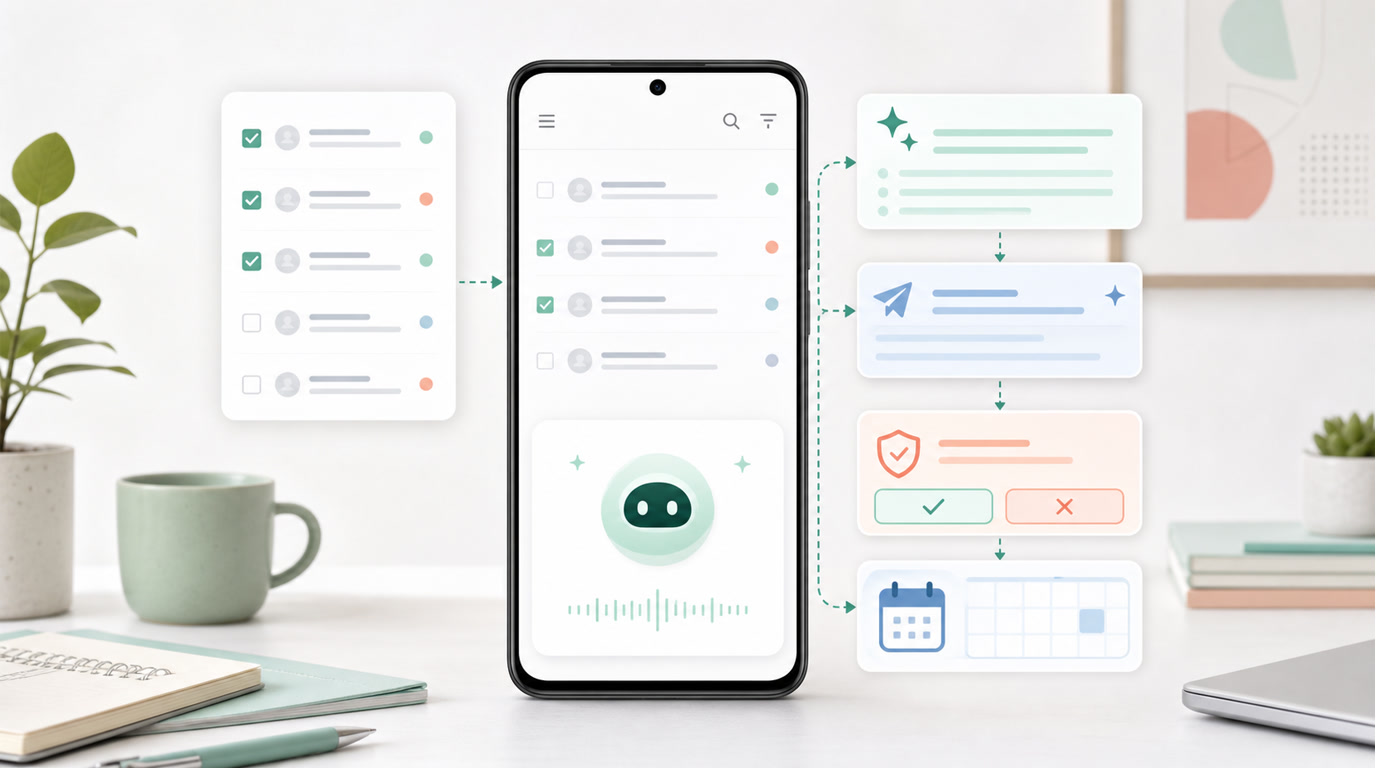
- An Android AI email assistant can help summarize selected messages, draft replies, improve wording, and prepare follow-ups, but a draft remains separate from a sent message or deleted mailbox item.
- Gmail Gemini and Outlook Copilot provide provider-native Android email assistance, with availability depending on account, plan, language, region, app version, and organizational setup.
- FoneClaw adds a governed phone-agent workflow for configured mail accounts: listing messages, reading selected mail, sending confirmed messages, deleting exact targets, and creating calendar follow-ups.
- The safest productive workflow is staged: choose a bounded inbox set, summarize with source context, draft for review, confirm consequential actions, and recover clearly when account, permission, or message state is uncertain.
What an Android AI Email Assistant Can Do Now
An AI email assistant on Android is useful when it keeps five states clear: finding mail, reading selected messages, summarizing what matters, drafting text, and performing an account-changing action only after review. Gmail Gemini and Outlook Copilot offer provider-native help inside their own Android apps. FoneClaw takes a phone-agent route: a configured model handles understanding and drafting, while governed Android tools perform supported mail and calendar actions on configured accounts.
The current choice starts with where the email lives and what outcome you need. If your Gmail or Outlook app already supports the AI feature you want, native assistance may be the fastest route for inbox summaries, reply help, and message coaching. If the task needs selected mail to turn into a broader Android workflow, such as a reviewed reply plus a calendar follow-up, FoneClaw is the more relevant phone-agent category.
The important distinction is state. A summary is a reading aid. A draft is proposed text. A send action contacts another person. A delete action changes mailbox state. A calendar event changes the user's schedule. A good Android email workflow should show which state it is in before the user approves anything consequential.
For broader writing-tool choices beyond mail, AI Writing Assistant on Android: Grammarly, QuillBot, and Where FoneClaw Fits compares general Android writing assistants separately. This guide stays focused on email-to-action work.
| Need | Best starting point | What to check |
|---|---|---|
| Summarize a Gmail or Outlook thread inside the app | Provider-native AI | Account, plan, language, region, app version, and admin setup. |
| Draft or rewrite a reply | Provider-native AI or FoneClaw | Recipient, claims, tone, links, and attachments before sending. |
| Move selected email into Android follow-up | FoneClaw | Configured account, selected message, action target, approval, and recovery path. |
Gmail Gemini and Outlook Copilot on Android
Gmail and Outlook both now document AI email features on Android, but availability is feature-specific. Google's Gemini features in Gmail help table lists Android support across items such as conversation summaries, Help me write, suggested replies, and eligible-plan side-panel summarization or drafting. The same table distinguishes account type, plan, language, and region conditions, which matters for readers who expect one Gmail feature to imply all Gemini email features.
Google also documents short Gmail summaries on Android. The Gmail summaries with Gemini guide says Android inbox summaries require the latest Gmail app and an eligible plan, and that summaries are based on message-thread content. It also gives users feedback controls and notes that AI suggestions can be inaccurate. In everyday use, that means summaries are helpful for catch-up, but source messages still matter when a deadline, amount, name, or commitment is important.
Microsoft's Copilot in Outlook FAQ applies to Outlook for Android and describes inbox triage, thread summaries, drafting, coaching, and scheduling paths. Availability can depend on account, subscription, language, and organizational setup. The official Draft with Copilot in Outlook guide also shows a review-first flow on mobile: the user can adjust, keep, discard, regenerate, edit, and then tap Send.
That makes provider-native AI strong when the work stays inside Gmail or Outlook. It already understands the app's message model, account context, and native compose flow. FoneClaw becomes useful when the user wants a selected email to continue into a governed Android phone workflow, especially where mail, app actions, reminders, and calendar changes need to be coordinated. For broader Gemini productivity context on Android, Gemini Productivity on Android: What It Helps With and Where Phone Agents Still Matter keeps the Google-specific question in its own guide.
Search, Read, and Summarize a Bounded Inbox Set
The best AI email summarizer Android workflow starts with a bounded set of messages. Instead of asking an assistant to read everything, define the account, sender, thread, label, unread state, date range, or topic. A bounded request gives the model better context and gives the user a clearer way to verify whether the result is complete enough for the decision at hand.
FoneClaw supports configured-account listing, message listing and filtering, and selected-message reading. That means the workflow begins by confirming which account is active and which messages match the request. Reading selected mail is still different from drafting or sending. It retrieves the context needed for the model to summarize, but it does not by itself contact anyone or change a mailbox item.
A useful summary is structured around the next decision. For a morning catch-up, ask for urgent decisions, deadlines, people waiting on you, and FYI-only messages. For a customer thread, ask for the latest request, promised date, missing details, and proposed reply. For travel, ask for confirmation numbers, check-in windows, locations, and dates worth adding to a calendar. The model should cite the source message or thread enough for the user to reopen it before acting.
Uncertainty deserves a visible place in the summary. If a date is relative, a sender is unclear, or a thread contains conflicting instructions, the assistant should flag that instead of smoothing it away. Google's smart features and controls documentation is a useful reminder that email AI features sit behind account settings and product controls. On the phone-agent side, FoneClaw keeps the selected mail set and next action visible so the user can decide whether the summary is enough.
Email catch-up also overlaps with notification triage, but the two are separate workflows. Email tools work with configured mail accounts and selected messages. Notification workflows work with phone notification context. For that adjacent use case, AI Notification Management on Android: Briefs, Triage, and Phone Actions explains notification briefs without turning every alert into an email task.
Draft, Review, and Send With Visible Confirmation
Drafting is where an AI email assistant can save time without rushing the user into an account change. A good prompt gives the model the desired outcome, tone, and constraints: "Draft a short reply confirming Tuesday afternoon, ask for the agenda, and avoid promising a final decision." The model can prepare a clean response, but the draft remains proposed text until the user approves sending.
Provider-native assistants already use this pattern. Microsoft's mobile Outlook flow lets the user keep, edit, discard, regenerate, or send after review. Gmail's Gemini features also include writing and suggested reply paths where availability depends on account and feature conditions. The useful design principle is consistent: text generation helps the user compose; sending is a separate step with its own consequences.
FoneClaw supports sending new mail, replies, reply-all, and forwards through confirmed mail actions on configured accounts. The configured model can draft the message, while FoneClaw's governed mail workflow handles the supported send action after the user can inspect what matters: account, recipients, subject or thread, body, links, attachments when supported, and whether the action is a new message, reply, reply-all, or forward.
The recipient check is not cosmetic. Reply-all can expose information to more people than intended. A forwarded message can carry thread history or attachments. A model-generated reply can contain a confident sentence that the source email never established. The review point should make the user look at the facts that change risk: who will receive the message, what is being promised, what material is included, and whether the tone matches the relationship.
Android also provides a standard composer route. The Android common intents for email documentation describes ACTION_SENDTO with the mailto scheme for opening a capable email app with recipient or subject details. That opens an email composer path; the user's email app and final send step remain visible. In a staged FoneClaw workflow, this can be useful when the safer result is to prepare the compose screen for final user action rather than complete a direct mail-tool send.
For high-stakes communication, records matter. A user should be able to understand what was drafted, what was changed, and what action was approved. AI Agent Identity, Permissions, and Audit Trails for Phone Tool Governance explains the governance layer behind approvals, attribution, and visible outcomes for phone-agent tools.
Delete, Uncertainty, and Recovery
Deletion deserves its own workflow because cleanup changes mailbox state. FoneClaw's current mail deletion capability targets exact selected messages. The user should see the account, message, sender, subject, and deletion type before the action continues. Trash and permanent deletion carry different consequences, and recovery windows vary by provider and account settings.
A safe delete request is specific: "Trash the selected shipping notification from this thread" is clearer than "clean up old mail." Bulk cleanup becomes risky when the selection criteria are vague, the mailbox contains similar names, or the assistant cannot show exactly which messages will change. When the result is uncertain, the better path is verification: recheck the selected message state, explain what completed, and ask for user direction if the mailbox response is unclear.
Summary and deletion also need separation. An AI email summarizer Android flow can identify likely stale messages, duplicate receipts, or completed threads. That is a recommendation. The delete action starts only when the user selects exact targets and confirms the account change. This keeps the workflow useful without turning inbox triage into hidden cleanup.
Turn Email Commitments Into Calendar Follow-Up
Email often contains the next calendar item before anyone creates it. A client proposes Thursday at 3:00. A school message mentions a form deadline. A receipt includes a booking time. A teammate asks for a follow-up next week. FoneClaw can use model understanding to extract the commitment, then use governed Android calendar tools to propose or perform a supported follow-up action after review.
The extraction step should name the source message and identify the necessary fields: title, date, time, timezone, calendar account, participants, location, reminder, and owner. Relative dates need concrete resolution. "Tomorrow" means a specific date based on the user's current context. "Next Friday" can be ambiguous in some regions and conversations. "After lunch" needs a time before it becomes a calendar event.
Google's smart features documentation includes examples such as summary cards, events from Gmail in Calendar, and Gemini summarization or drafting under user settings. That is provider-native convenience inside the Google ecosystem. FoneClaw's role is different: it can list calendars and create, search, update, or delete Android calendar events through supported workflows, with confirmation when the task changes the user's schedule.
A realistic email to calendar workflow has four steps. First, summarize the selected message or thread and extract the candidate commitment. Second, ask for missing fields instead of guessing. Third, show the proposed event with account, time, title, location, and reminder. Fourth, create or update the selected calendar item only after approval. If the follow-up belongs as a reminder rather than a calendar event, the assistant should make that distinction visible.
This is where an email assistant becomes a practical Android productivity agent. It does not stop at a polished reply. It helps convert a selected message into a reviewed next step. For broader multi-step phone workflows, Automate Android Tasks With One Voice Command shows how supported Android actions can be chained while keeping review points visible.
Choose and Test an Android Email Workflow
Choose Gmail Gemini or Outlook Copilot when the useful result stays inside that provider's Android app and your account meets the feature requirements. Choose FoneClaw when the task needs selected mail to become a governed phone workflow: a reviewed reply, an exact deletion, a calendar follow-up, or a sequence that combines mail with other supported Android actions.
The current FoneClaw release information describes improvements to mail presentation and long-text actions, session-bound approvals, task isolation, permission recovery, and execution-flow recovery. Those improvements matter in email because long threads, multiple drafts, and pending approvals can otherwise blur together. FoneClaw's supported Android actions give the model a governed path for practical phone tasks such as selected mail review, confirmed messages, exact deletion, calendar follow-up, app launch, visible screen checks, and recoverable multi-step routines.
| Test | What to do | What good looks like |
|---|---|---|
| Selected-message summary | Pick one account, one thread, and one summary goal. | The answer identifies decisions, dates, and uncertainty without over-reading the inbox. |
| Draft-only reply | Ask for a short response with clear tone and constraints. | The draft is editable and remains separate from send approval. |
| Confirmed send | Review account, recipient, subject, body, links, and attachments. | The user approves the exact message action. |
| Calendar follow-up | Extract a commitment and show the proposed event. | Date, timezone, calendar, title, and reminder are visible before creation. |
Start with the lowest-risk path: summarize one selected thread, draft a reply without sending it, then create a reviewed calendar reminder from a clear date. Once that feels predictable, expand to more complex workflows. For the wider phone-agent model behind these steps, AI Agent Phone Control: How Android Phone Agents Turn Intent Into Action explains how intent becomes supported Android execution.